
 Get self-health education, nutrition resources, and a FREE copy of A Terrible Ten: Health Foods That Ain't ebook.


What a crazy notion, right? Thyroid issues causing shoulders problems, Dr. Keppel where do you come up with these things? Well, the truth is…I didn’t come up with this. Although I do not know the exact origin of this line of thinking, I can tell you where I first heard about it. I was listening to Dr. Scott Walker speak at a Neuro-Emotional Technique seminar in the 90’s. I am sure Dr. Walker got it from Dr. George Goodheart (of Applied Kinesiology fame). Since then, I have been using this approach in my practice, with wonderful results.
In 1964, Dr. Goodheart proposed that organs and glands are associated with specific muscles of the body. If the organ is not functioning at 100% then the muscle associated with it may become inhibited, causing the joint to be unstable and not move properly, thus creating pain and long-term degeneration.
I know what you are thinking, “This sounds great in theory but give me some proof!!” Ok, no problem.
Some time ago I decided to search “thyroid issues and rotator cuff issues” on Google AI. This is what AI had to say:
“A new epidemiological study suggests a strong link between thyroid disease and rotator cuff tears, particularly in women. Females with thyroid disease, especially those in the 60-80 age group, show a significantly higher incidence of rotator cuff tears. This association is not solely related to age, as the study also found that males over 80 with hypercholesterolemia had a higher incidence of tears. These findings highlight the potential role of thyroid hormone receptors in tendon metabolism and their impact on rotator cuff health”.
As you can imagine there was excitement. Finally, justification for years of telling patients their shoulder issue were caused by their thyroid. But again, I needed more proof. There was a study published in The Journal Muscle Ligaments Tendons Nov.17, 2014, which can be found in the National Library of Medicine, “Epidemiology of the rotator cuff tears: a new incidence related to thyroid disease.” The study from Italy concluded, “This is the first clinical report that shown a relationship between thyroid pathologies and non-traumatic rotator cuff tear as increased risk factors.”
Now, what is the mechanism? It may be a while before we find out for certain. One theory is a lack of thyroid hormone (thyroxine) in the tendons and muscle fibers. Another possibility is that a lack of thyroxine in the cells causes a swelling of the cells. The famous Endocrinologist Henry Harrower, (you can find his book here) talked about the single most important thing that occurs as a result of hypothyroidism “cellular infiltration.”
This can lead into hypothyroidism and carpal tunnel syndrome. According to The Mayo Clinic in their article, Hypothyroidism: Can it cause peripheral neuropathy?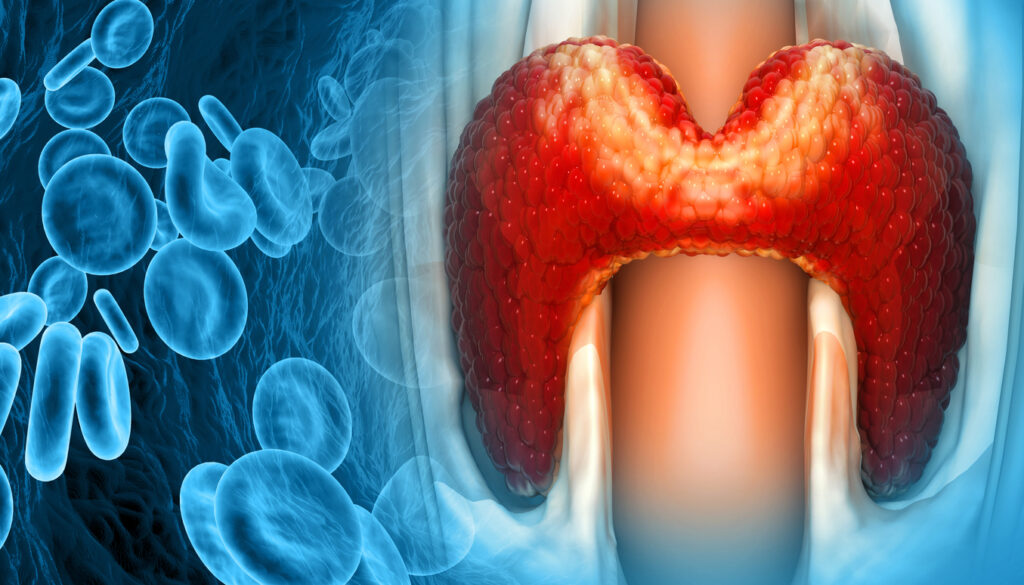
“The link between hypothyroidism and peripheral neuropathy isn’t fully understood, but hypothyroidism can cause fluid retention that leads to swollen tissues. This can put pressure on peripheral nerves.
“This most commonly occurs in the wrists. The nerve responsible for hand function goes through a “tunnel” of soft tissue. This soft tissue can swell and press on the nerve, resulting in carpal tunnel syndrome.”
Notice the reference to swelling. It sends me back to Harrower’s cellular infiltration.
The simple way to check your thyroid at home is the reliable Barne’s Temperature test. Using a mercury style thermometer, take your temp in your bare armpit very first thing in the morning when you awaken. Do not get out of bed, just slowly reach for the thermometer place it in your arm pit then lie back down for 10 minutes and record the temp. Give these records to your holistic healthcare provider.
There is a simple Standard Process Protocol for Hypothyroid that includes: Thytrophin PMG, Cataplex F, Cataplex C and Circuplex.
Boy-oh-boy, is this good to know!
Next time let’s look at knee issues and gallbladder troubles.
Images from iStock/Panuwat Dangsungnoen (main), Mohammed Haneefa Nizamudeen (thyroid image).

Dr. Keppel received a Doctor of Chiropractic degree from Logan College of Chiropractic in 1983, following an associate degree in science from Southwestern Michigan Community College. He became certified in Neuro-Emotional Technique in 1999, having studied directly under the program’s founder, Dr. Scott Walker. He has undertaken a variety of further training, including herbology, spinal rehabilitation, and ongoing nutritional education.
Dr. Keppel knows there is always some seminar, book or journal that might deepen his knowledge or contribute one more bit of information that he can directly translate into an effective treatment. He gives sound advice from the perspective of clinical experience and years of practice.
More recently, Dr. Keppel has been teaching seminars for Standard Process West. He has become their in-house chiropractor and is recognized as a mentor for other practitioners throughout the greater Denver area.
For more information, visit his website at DoctorKeppel.com, check out his YouTube channel, or contact him directly at drkeppel@gmail.com.
Products by Dr. Lowell Keppel
Charts & Posters
Digestive Flow & Nutritional Support Chart by Dr. Lowell Keppel

Dr. Lowell Keppel
