
 Get self-health education, nutrition resources, and a FREE copy of A Terrible Ten: Health Foods That Ain't ebook.

Every day for the past three weeks I’ve been milking sheep and making cheese. Since writing our book, Mootopia, Mary and I have wanted to live in a place where we could keep cows and sheep, to have our own supply of raw milk for yogurt and cheese making. Sheep milk is the best milk for drinking, making yogurt, and making cheese – it has superior nutrition and flavor.
People eat sheep milk cheeses frequently, without even knowing: Pecorino, Manchego, Roquefort, and many others. The tradition of milking sheep is not well-known in the US because – well, for no good reason that I can think of.
Even after watching Mary make cheese in our kitchen, I was anxious about doing it myself. Every time I read about cheese making, it’s sterilize this, sterilize that, measure your acidity, watch your temperatures. I’m not good at following directions, as you may have noticed. Then I watched a YouTube video of a mom in her kitchen, making raw milk cheddar with an infant on her hip and 3 other young kids milling about, playing in the kitchen, and watching her work. Obviously not a sterile environment. I didn’t notice any pH strips or thermometers. Hey! She just put her hand in the milk to see if it was the right temperature!
OK, I thought, this is something I can do.
Jean Noon, now in her 70s, kept her sheep at our farm for several years when I was growing up here. Then she and her husband Bill bought their own farm a mile or two down the road, where she still keeps a flock of triple-use sheep, producing meat, wool, and milk. Though she had gone to some trouble to add milking genetics to her previously meat and wool flock, it has now been several years since they were milked.
When Jean expressed this to me, regretfully, I immediately formed a plan. Before bringing sheep back to this farm, I could get some hands-on experience with milking and see if I could make cheese every day without it ruining my life. So I offered to come milk her sheep every day for a month, and she agreed.
I wanted to start milking by hand, in order to get the feel of it. I thought if I started milking with a machine, I wouldn’t understand as well what was happening – udder, teats, brain, legs, rumen, adrenaline, oxytocin. There’s a lot going on in milking a sheep and I wanted to get up to speed with the physicality of it, rather than bypassing via technology.
Even with hand milking, there’s still a lot of equipment involved. The stanchion that holds the animal so she won’t back up into the milking pail, the little grain bucket as reward to ensure enthusiasm, a warm soapy rag and a dry rag for cleaning the udder, two different tit-washes to dip the teats in before and after, a milking pail, glass jars to transfer milk into, and a sieve and cheesecloth for straining the milk from the pail. It’s a process and a workout.
The first day I did not get very much milk and struggled to get my hands in a position that worked and felt comfortable, but by the end I kind of got the hang of it. Day two I concentrated on speed. Day three I focused on relaxing and getting the most volume from each pull. Day four I felt like I was milking.
Then I ordered the simplest, cheapest milking device — a hand operated pump with two large syringes serving as teat cups. It arrived a week later and works after a fashion. The milker gets half to three quarters of the milk out, faster than hand milking, with less spillage. Then I still have to finish by hand.
Jean’s been separating the lambs every morning. We milk the ewes once a day in the evening, before reuniting the lambs and mothers at night. These lambs are old enough to wean, but Jean is keeping them on the ewes until the pasture has greened up enough for them to go out into the grass. Today, Mary and I ate a Pecorino Stagionato that I had made a week ago. So very fresh and delicious! I brought part of it to Jean, along with a small jar of sheep ricotta.
When I got back home after milking, I first poured out a batch of 2-day old clabber to drain, in cheese cloths on sieves over bowls (I’ll explain clabber below). Then I used the (acidic) whey that drained off the clabber as culture for today’s milk, still warm from the udder, mixing it in a large stainless steel bowl that fits snuggly into a tall pot half filled with hot water. I brought the cultured milk up to about 95F, slowly over about 30 minutes, giving the pot a minute or two of heat from the stove at the end.
Then I mixed some organic calf rennet in a bit of water and mixed that into the cultured milk, put the cover back on, and waited another half hour. I knew I had put too much rennet in, when I impatiently squeezed the dropper bottle too hard. Normally, I would have waited an hour. But sure enough, after 30 minutes the curd was quite set and at risk of going rubbery on me. So I cut it and let it sit a few more minutes while I prepped the forms.
Then I took a whisk and chopped the curd finely. Rather than draining the curd, I put the forms right into the whey and mushed masses of small curds into the molds, one after the other. Doing it this way ensures there are no air gaps in the cheese. The curd is pressed firmly, by hand, into the form, forcing the whey out. After a few minutes of draining, I can pop out the cheese, flip it, and push it back in, upside down, and again tightly press it by hand.
Tomorrow I will salt all sides of the cheese and leave it to drain some more. Then flip and salt it several more times during the next 2-3 days before setting it in the fridge to age. After a week, this will be the same, delicious Pecorino Stagionato as we ate for lunch. If we can refrain from eating one of these for six months, it would cross over into being Pecorino Duro. But we need a cave at 57 degrees if we plan to age these cheeses, the fridge is too cold. At about 12 months, Pecorino becomes a grating cheese. Hmmmmm.
Clabber is the most amazing thing. I thought I knew everything there was to know about milk. Nope. Clabber is wild! Did you know that good milk – fresh and raw – does not go sour? What? No, it doesn’t. It clabbers.
You take fresh, warm milk from any ruminant animal such as cow, goat, sheep, or buffalo, and simply put it in a jar on the counter at room temperature. Put the lid on, but keep it loose not tight. Then you wait. Clabbering takes 24 to 48 hours, depending on temperature and probably a bunch of other factors. Just wait. If you make it every day, you can use yesterday’s clabber as a starter and it will only take a day to re-clabber. I don’t make it every day, so mine always takes 2 days. It’s worth the wait. After a few tries where I was scared to leave it long enough, I finally waited 48 hours and wow, that’s some flavor!
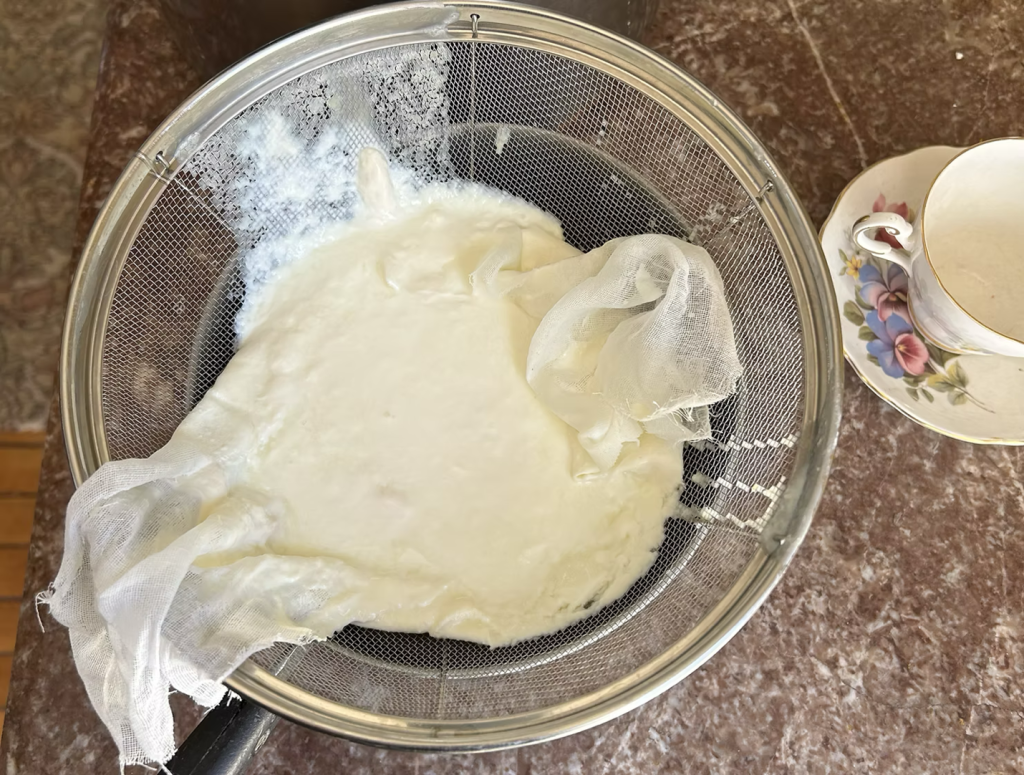
Clabber is like yogurt but really nothing like yogurt. Yogurt is an elegant woman in a beautiful dress. Clabber is a wild Bacchanal dressed only in wildflowers and rabbit pelts. The thing is: raw milk already has all the beneficial bacteria, archaea, yeasts, and fungi in it to make every kind of cheese. Raw milk is an ecosystem. It is complete. Clabber has all the flavors all at once.
The only reason yogurt and cheese makers add culture is that they kill their milk first. Even good raw milk yogurt gets heated and held at 180F for long enough that water evaporates to thicken the milk, before cooling and adding culture back in. Living milk is the most amazing thing. But it has to be raw, fresh, and from a clean, healthy environment, not a sterile environment, nor a filthy one. Raw milk defends itself from ambient contamination unless seriously compromised.
That said, after 48 hours, you must refrigerate your clabber, or it will go places you don’t want to follow.
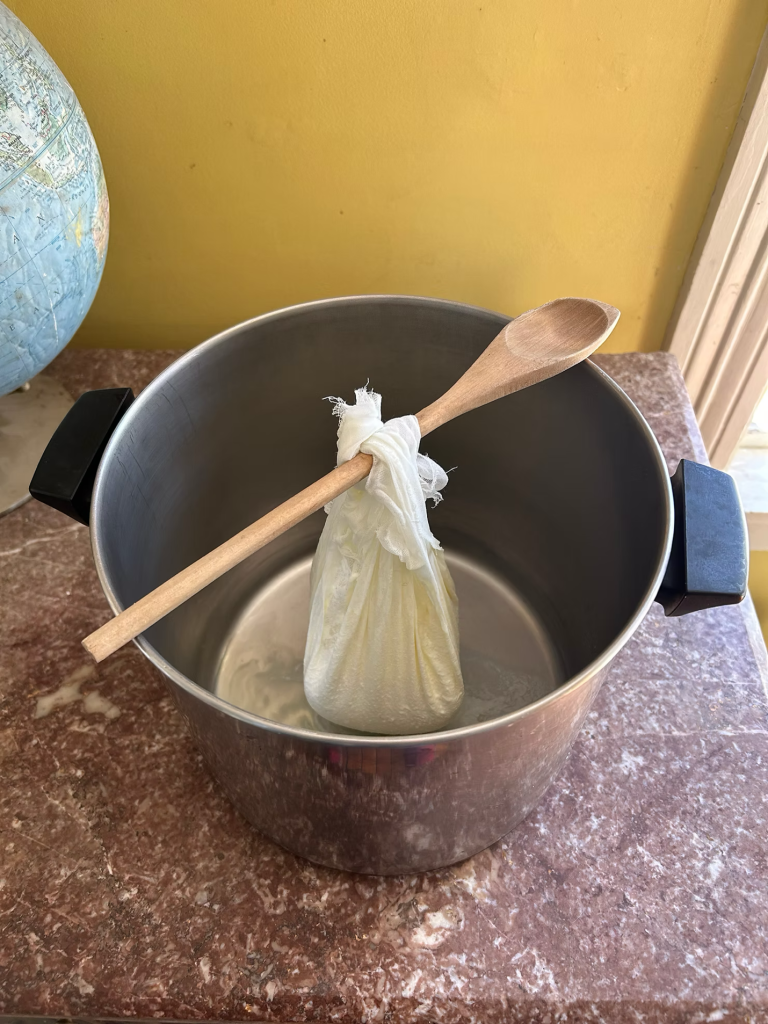
Tonight, when I strained the clabber to get whey for tonight’s cheese-making session, I was hanging the clabber in cheese cloths to make round cheeses right from the clabber. These will be the wild cousins of labneh, or yogurt cheese. Tomorrow I will unroll them from the cloths, salt them, and then hang them again for a second day. Then they can be festooned with fennel or rondelled in rosemary or swathed in sumac, and served.
I expect they will be eaten – gluttonously — before an hour is out.

