
 Get self-health education, nutrition resources, and a FREE copy of A Terrible Ten: Health Foods That Ain't ebook.

Rethinking Grains: From Misunderstood Carbs to Metabolic Allies
For decades, grains have been unfairly blamed for fueling obesity and chronic disease. Low-carb trends from keto to paleo have convinced many people that cereals are the enemy of a healthy metabolism.
But the truth is more nuanced: the problem isn’t the grain itself, but how we process it.
When whole grains are stripped of their bran and germ to produce white flour or polished rice, what remains is a rapidly digestible starch that spikes blood sugar and insulin. Repeated over years, this refined pattern promotes weight gain, insulin resistance, and type 2 diabetes.
Whole grains, on the other hand, are completely different foods. They retain the natural layers that slow digestion and deliver fiber, vitamins, minerals, and phytochemicals. In large population studies, regular consumption of whole grains is linked with a 20–30 percent lower risk of developing type 2 diabetes and heart disease.
Among all cereals, one stands out: barley (Hordeum vulgare L.) the most ancient yet scientifically advanced of the grains.
Why Barley Is Different
Barley has nourished humanity for more than 10,000 years. Once central to Mediterranean and North-African diets, it is now re-emerging as a nutritional powerhouse because of one remarkable compound: β-glucan.
β-glucan is a soluble fiber concentrated in the inner layers of the barley kernel. When hydrated, it forms a gentle gel that slows the absorption of glucose and cholesterol in the intestine. This property explains barley’s exceptional ability to flatten post-meal blood-sugar spikes, support heart health, and promote a lasting feeling of fullness.
Modern plant breeding has revived hull-less (naked) barley, a variety that naturally sheds its outer husk during harvest. Unlike conventional hulled barley, it keeps all the nutrient-dense layers intact, preserving more fiber and minerals. Hull-less barley therefore requires less processing, has a softer texture, and delivers a higher β-glucan yield per serving. It is, quite simply, barley in its purest and healthiest form.
Science You Can Trust: What the Studies Show
1. A Landmark Finding
One of the earliest modern studies on barley and blood sugar was published in Plant Foods for Human Nutrition in 2005 by Rendell et al. The researchers compared a breakfast made from Prowashonupana, a waxy, high-fiber, hull-less barley with oatmeal and a standard liquid meal. Both healthy and diabetic participants experienced a dramatic reduction in post-meal glucose levels after eating barley. In diabetic volunteers, blood-sugar rises were less than half of those caused by oatmeal. Barley also triggered a much smaller insulin response, showing that the body handled the meal more efficiently and gently.
2. Modern Confirmation
Nearly two decades later, a randomized double-blind trial published in Nutrients (2024) by Kim et al. reaffirmed those results using Saechalssalbori, a glutinous hull-less barley rich in β-glucan. Over three hours of monitoring, volunteers who consumed the barley beverage had lower blood-glucose and insulin curves and felt significantly fuller than those who drank a rice-flour placebo.
3. Support in Diabetic Patients
Clinical improvements are not limited to healthy subjects. In a 2019 trial published in the International Journal of Innovative Science and Research Technology, Azam et al. provided 100 grams of barley porridge daily to individuals with type 2 diabetes for four weeks. The results were clear: fasting and post-meal blood-glucose levels dropped significantly, and patients reported better energy and well-being.
How β-Glucan Works in the Body
Barley’s β-glucan operates on multiple fronts:
- Slows digestion and glucose release.
- Feeds the microbiota.
- Improves lipid metabolism.
- Regulates appetite.
This elegant fiber acts as both a mechanical and hormonal regulator, connecting gut, liver, and brain in a seamless loop of metabolic harmony.
Approved Health Benefits
Both the European Food Safety Authority (EFSA) and the U.S. FDA officially recognize barley β-glucan for two proven physiological effects:
1. Helps lower blood cholesterol (≥3 g β-glucan/day).
2. Helps maintain normal blood-glucose levels after meals.
These are not marketing claims, they are scientifically validated statements supported by controlled human trials.
Hull-less Barley: The Future of Functional Grains
The key distinction between hulled and hull-less barley lies in the presence of a tightly adhering husk. In hulled types, this outer hull remains attached after threshing and must be removed mechanically, a process that strips away portions of the bran and aleurone layers, the very tissues richest in β-glucan, minerals, and vitamins. By contrast, hull-less barley naturally sheds its husk at harvest, preserving the grain’s full nutrient profile.
Nutritionally, hull-less barley contains up to 30% more soluble fiber and higher protein as its intact cell-wall matrix slows starch digestion. From a technological viewpoint, it yields more flour during milling and eliminates the energy cost of dehulling, making it both economically and environmentally advantageous.
In short, hull-less barley represents a new generation of functional grains: nutritionally superior, easier to process, and aligned with clean-label, minimally refined food systems.
Practical Guidance: Bringing Barley Back to the Table
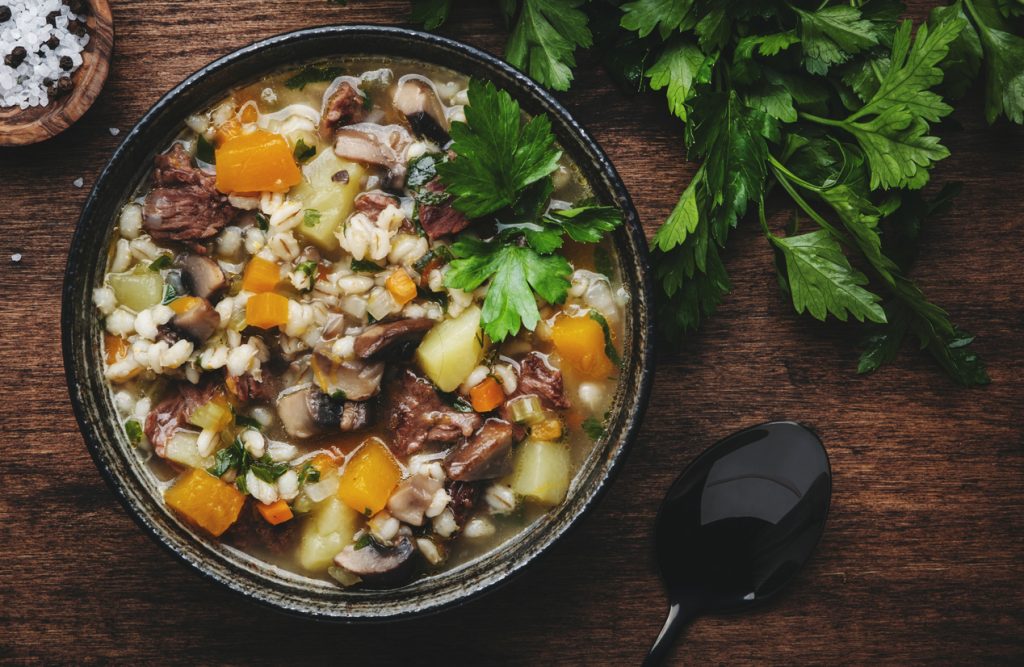
To achieve the scientifically effective intake of 3–6 grams of β-glucan per day, try the following:
- Breakfast: whole-barley porridge (1 cup) 3–4 g β-glucan.
- Lunch: add ½ cup cooked hull-less barley to salads or soups — 1–2 g.
- Dinner: barley pasta, couscous, or stew — 2–3 g.
Select whole barley (inedible hull is removed but nutritious bran, germ, and endosperm remain intact), or hull-less barley rather than pearled forms. Pair barley with healthy fats (like olive oil or nuts) and protein to extend satiety and stabilize blood sugar.
A Grain of the Past, A Medicine for the Future
Barley reminds us that nutrition and medicine once spoke the same language. What ancient cultures used to strengthen the body and calm the spirit now finds its confirmation in peer-reviewed science.
In every bowl of barley porridge or slice of barley bread lies a gentle medicine, one that works not through restriction, but through restoration.
Barley doesn’t fight metabolism, it restores it.
Where to Find Organic and Heirloom Barley
For readers who wish to experience the flavor and nutrition of authentic barley, several reliable seed and grain suppliers offer organic and heirloom varieties:
- True Leaf Market: Organic Purple Barley, a naturally hull-less heirloom rich in β-glucan.
- Black Hulless Barley Seeds | Baker Creek Heirloom Seeds: Black Hull-less Barley and Bere Barley, ancient strains prized for their resilience and taste (organic certification not specified).
- La Société des Plantes: Tibetan Hull-less Barley, a heritage landrace grown under ecological farming practices in Canada.
Choosing heirloom and organic sources ensures that the grain’s full nutritional integrity including its β-glucan content and flavor diversity is preserved.
References
1. Rendell M, Vanderhoof J, Venn M, Shehan MA, Arndt E, Rao CS, Gill G, Newman RK, Newman CW. Effect of a Barley Breakfast Cereal on Blood Glucose and Insulin Response in Normal and Diabetic Patients. Plant Foods for Human Nutrition. 2005; 60: 63–67.
2. Kim JY, Park SY, Park MJ, Kim KJ, et al. Effect of a β-glucan-rich hull-less barley (Saechalssalbori) on postprandial glucose, insulin and satiety in healthy adults: a randomized, double-blind, placebo-controlled trial. Nutrients. 2024; 16: 3899.
3. Azam A, Itrat N, Ahmed U. Hypoglycemic Effect of Barley (Hordeum vulgare L.) in Type 2 Diabetic Patients. International Journal of Innovative Science and Research Technology. 2019; 4(10): 137–145.
4. EFSA Panel on Dietetic Products, Nutrition and Allergies (NDA). Scientific Opinion on the Substantiation of Health Claims Related to Beta-Glucans and Maintenance of Normal Blood Cholesterol Concentrations. EFSA Journal. 2009; 7(9): 1254.
About the Author
Ghizlane Salih is a food scientist and researcher at INRA Morocco specializing in cereal science and the development of functional foods from barley.
Her work bridges ancient grain wisdom and modern nutrition, exploring how barley can support metabolic health.
Through her platform Barley for Health, she shares science-based insights on the nutritional, historical, and culinary value of this remarkable grain.
Images from iStock/allou (main), 5PH(post).


Excellent read. My first time reading, delving into barley, I wasn’t aware there were more than one type of barley to look for. I will start using it myself so I’ll have practical and education knowledge of barley. As a health coach, I’m always searching and researching to find the best and honest information to share with my clients and audience…..Thanks, great work.. Alonzo, Health Coach….Canada
That was my experience as well, Kent! Hulless barley, what a concept. I’ve been cooking with it and it’s great. Our site is full of quality honest information so I’m glad you found us! We’ll make sure the author gets your message.
Thank you very much, Alonzo, for your kind and thoughtful feedback.
I’m truly glad to hear that this article helped you discover the diversity of barley varieties and inspired you to explore barley both practically and scientifically. That balance between hands-on experience and evidence-based knowledge is exactly what motivated me to write this piece.
As a health coach, your commitment to sharing reliable, high-quality information makes your message especially meaningful to me. If you’re interested in going further, I also share complementary, science-based content on my blog about barley, nutrition, and metabolic health, which may be useful in your practice.
Thank you again for your careful reading and for taking the time to share your thoughts.
Ghizlane Salih