
 Get self-health education, nutrition resources, and a FREE copy of A Terrible Ten: Health Foods That Ain't ebook.
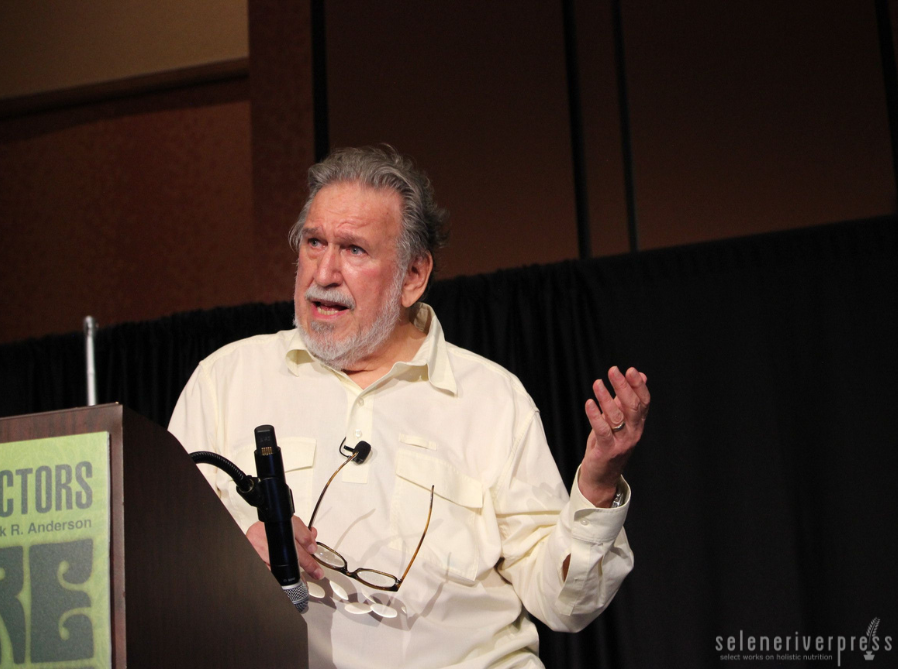
We were rewatching some of Mark’s presentations recently. Familiar material from different years. The more we watched, the more something odd started happening.
The subjects do not appear to have much in common at first. Two presentations move through clinical observations from Dr. Royal Lee. Another spends more than an hour with salt. An older webinar goes into the organization of the immune response. Different years. Different subjects. Different clinical questions.
Yet the farther we went, the more they kept circling back to the same critical truth:
“The higher you go in any sphere of learning, the more fundamental data gains new meaning.”
Continuing on this note, Mark pointed out that as practitioners accumulate knowledge, the basic material does not necessarily become basic. Experience gives it more places to connect.
“So much is built on the fundamentals,” he went on. “You don’t always realize how much is resting on those fundamentals until you get higher and higher and higher in that sphere of knowledge.”
Anyone who has been in practice for a while probably recognizes the experience. You return to something you learned years ago and find considerably more in it than you remember. Perhaps the material changed. More likely, you did.
The Clinical Pearl Is Rarely an Isolated Pearl
Clinical Pearls from Dr. Royal Lee — August 20, 2025
The first Clinical Pearls from Dr. Royal Lee was intentionally arranged differently from many Webinar Wednesdays. Mark described it as a “rapid fire training session,” moving through short selections from Lee rather than developing one subject for the entire presentation. That format makes an interesting thing happen.
A clinical observation is allowed to stand briefly on its own. Then another appears. And another. What initially seems like a collection of historical curiosities begins to expose the habits of mind underneath them.
Lee continually comes back to relationships.
A nutrient has a physiological setting. A tissue has requirements. Foods contain complexes rather than conveniently isolated textbook factors. The significance of one substance often depends upon what accompanies it, what it supports, and what the body is attempting to do with it. Mark has spent years returning to those distinctions. Sometimes with considerable amusement at how long it can take for an old nutritional observation to become interesting again.
The point is especially noticeable when the subject becomes something as ordinary as salt.
When “Too Much” is an Incomplete Question
Physiology of Salt — September 6, 2023
Salt seems almost too elementary for the occasion. For the month of back to school for Doctors, it’s a curious choice. That’s exactly what makes the webinar useful.
Mark goes back to a 1951 article by Dr. Royal Lee on the physiology of salt metabolism. Lee begins with sodium chloride as an essential constituent of body fluids and discusses its relationship to osmotic movement of water, perspiration, and renal elimination. Then the discussion turns.
Why, if salt participates in normal physiology, had the conversation become so heavily centered on restricting it? Lee’s answer brings in potassium.
“There must be a normal balance between sodium and potassium salts in the body fluids,” Mark reads from the 1951 material.
Now the question has changed. The practitioner is no longer looking at sodium as an isolated quantity. Sodium is being considered in relation to potassium, body fluids, kidney function, water movement, and the larger mineral environment.
That distinction is easy to miss because isolated quantities are easy to discuss. They give us numbers. They fit neatly on labels and laboratory reports. They make it possible to call something high or low. But physiology is less accommodating.
Mark returns to the sodium-potassium relationship later in the presentation and points out, with characteristic satisfaction, that newer discussions of sodium and potassium had arrived at territory Lee was writing about decades earlier.
Whether one agrees with every historical interpretation is a separate question. What matters for the practitioner following Mark’s argument is the clinical habit underneath it: before deciding what a number means, ask what it is in relationship with.
That habit travels surprisingly well. But here’s where it gets interesting: Immunology.
An Immune Response Is an Alliance
The Alliance of the Immune Response: Turning Defense into Offense — August 18, 2021
In 2021, Mark devoted a Webinar Wednesday to this topic. The following month, he reminded his audience that the August 18 presentation had been a “required” homework assignment for Back to School for Doctors:
“A refresher class that, like strong immunity, never gets old.”
The title itself gives away something important. He calls it an alliance.
Immune physiology quickly becomes difficult to understand when its participants are separated into individual facts to memorize. Cells, signaling, barriers, recognition, response, and regulation have meaning because they operate together. A defense response is coordinated physiology.
Wait. The salt discussion does this. It moves from “how much sodium” to “sodium in relationship to potassium, fluid, kidney function.” And the immunity presentation does the same thing. Just with different components.
The principle is identical.
With salt, the thinking moves from the amount of one mineral to the relationship between minerals and the physiology they support. With immunity, attention moves from a single immune component to an organized response.
That shift matters clinically because patients rarely arrive with problems that respect the boundaries of our categories. The immune system does not live in an isolated chapter of the body. Neither do minerals. Neither do digestion, endocrine signaling, circulation, or nervous system regulation.
The body keeps crossing the lines we draw around it.
Why the Old Material Changes
Clinical Pearls from Dr. Royal Lee, Part 2 — September 3, 2025

This may explain why Mark and Dr. Lee can spend so much time in the same Webinar Wednesday without the historical material feeling entirely historical: Lee’s work supplies observations and a particular way of looking at nutrition. Mark keeps testing those ideas against physiology, later literature, products, clinical experience, and questions that practitioners are still asking.
Sometimes he agrees enthusiastically. Sometimes he uses an old statement as a starting place for a much longer discussion. And sometimes his delight comes from discovering that a physiological relationship described decades ago has resurfaced in newer language. He has seen, over and over, that a useful physiological question can remain useful.
What could Mark have done instead? Presented Lee’s recordings as historical artifacts. Instead, he stops them. Comments on them. Connects them to current material. Asks the listener to consider what the observation means in a larger clinical context.
By Part 2, he has already explained why: Fundamental information gains meaning as the structure around it grows.
A new practitioner can learn that sodium and potassium have a relationship. An experienced practitioner hears the same statement while thinking about diet, fluid regulation, kidney physiology, cardiovascular considerations, medications, laboratory findings, and the patient sitting in front of them.
The sentence stayed the same. The number of connections did not.
The Part We Sometimes Skip
There is a temptation in clinical nutrition to keep moving forward. Another paper. Another test. Another pathway. Another product. Another mechanism to add to an already crowded mental library. There is nothing inherently wrong with adding information. The problem comes when the new information has nowhere sturdy to attach.
That is where these webinars meet. The Clinical Pearls presentations return to old observations after years of accumulated experience. Physiology of Salt takes a familiar mineral and refuses to consider it outside its physiological relationships. The Alliance of the Immune Response asks us to think in terms of coordinated function rather than isolated pieces. None requires abandoning complexity. They require enough familiarity with the fundamentals to make complexity useful.
Mark’s comment at the beginning of Clinical Pearls, Part 2 makes more sense after spending time with the other presentations. The farther practitioners move into physiology, the more consequential the relationships underneath it become.
This is also one of the pleasures of having so many years of Webinar Wednesday in the archive. A presentation from 2021 can change the way you hear one from 2025. A discussion of immune physiology can sharpen a later conversation about minerals. Dr. Lee’s 1951 writing can turn up in a 2023 webinar and send the practitioner back into a question that seemed settled long ago. The archive was not created as one continuous course. In places, it begins to behave like one. August seems as good a month as any to notice.
Perhaps going back to school does not always require finding something new to study. Sometimes it means returning to material we thought we already knew and discovering how much more is resting on it.
Images from iStock/kentoh (human man with arms out), Oleksandr Melnyk (immunity scale).

